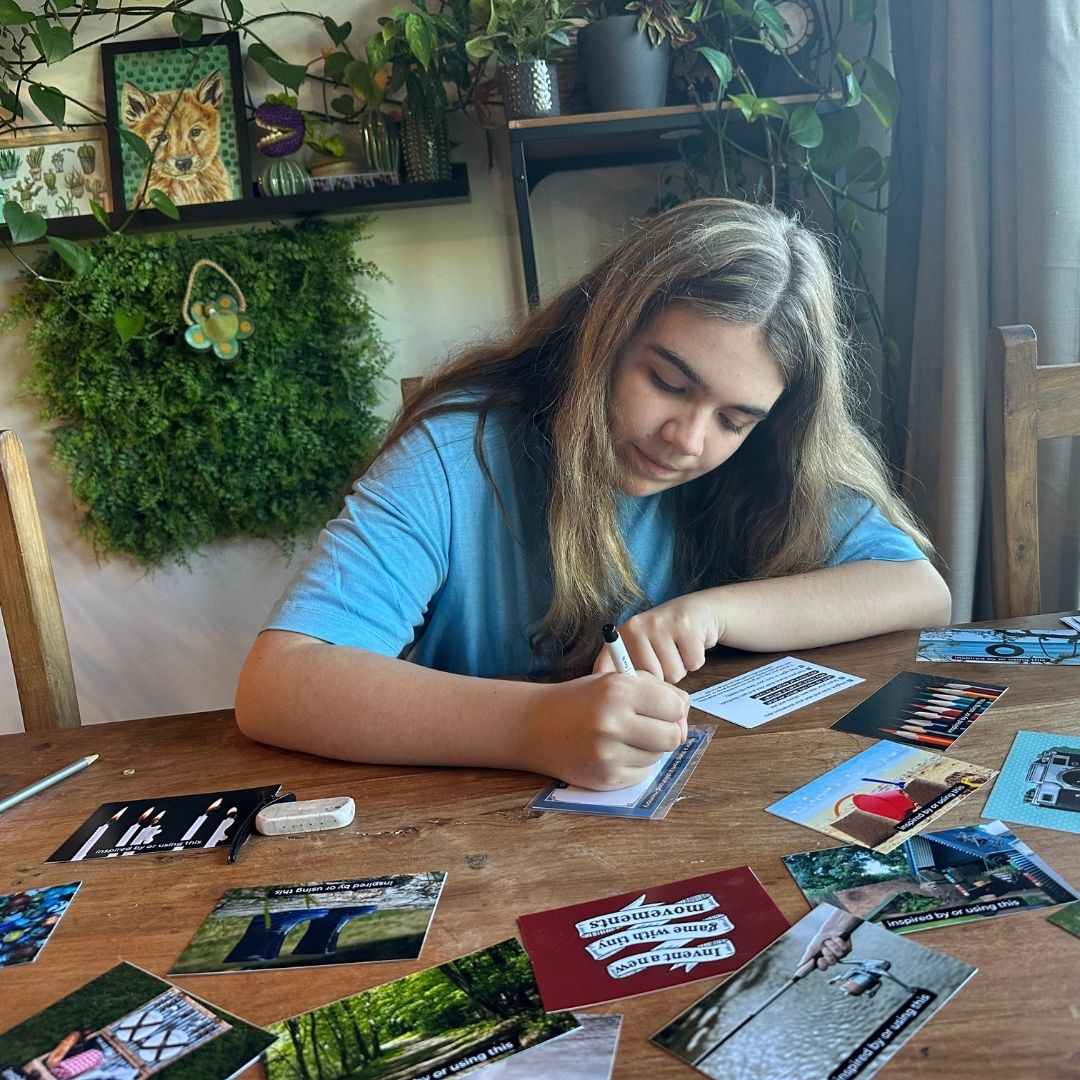
 Molly and U Shape Us, set up and ready to welcome people in Molly and I were thrilled to be part of Alt Games Festival in Sydney, hosted by the Powerhouse Museum on 18–19 April 2026. We were set up in the foyer of PHIVE in Parramatta, with U Shape Us, a simple imagination game using four prompt cards to help people invent and share new ways of connecting, running across three tables. Over the weekend, 96 people of all ages came and played, including 17 family groups, groups of adults, and individuals from teens to seniors, a mix of non-gamers, light gamers, and hobby gamers. It was a great opportunity to spend time with the community and Powerhouse staff, and to explore the role creativity can play in helping people feel a sense of belonging. While the game itself didn’t require facilitation, actively welcoming people into a short 10-minute experience made a noticeable difference. Both we and the Powerhouse team found that a simple, human invitation often shaped whether people stepped in at all. It highlighted how much a game experience depends on the conditions we create, not just the activity itself.  Playing U Shape Us at Alt Games 2026 How people experienced U Shape Us I asked people about their impressions of U Shape Us and where they saw it being of use. Some of the reflections from participants included: The low barrier to entry, the lack of competition and pressure to perform, was seen as important. Several people mentioned it felt like a gentle way to start creating without pressure. One person described it as a useful “warm-up” activity, even for confident creatives, because it helped them step outside their usual thinking patterns. Another described it as a space where you can be vulnerable with creativity, even if you feel you’re not creative or want to be more creative. Ideas that travel beyond the game Several young adults across different play groups said they saw it as a useful prompt tool for creative work, like writing, songwriting, and art. Others saw potential in workplace contexts, particularly as an easy entry point for brainstorming. A few also spoke about its potential in design, marketing, and business contexts, as a way of generating new ideas and stepping outside habitual ways of thinking. The space between activities and games U Shape Us was described as sitting somewhere between conversation cards and an imagination game, something familiar, but also different in how it opened up thinking. One person mentioned it was very different from traditional conversation cards. They appreciated that it didn’t require sharing personal memories, which they found uncomfortable, especially when those memories held grief. It felt more optional, more invitational, and focused on idea sharing. One person mentioned it sat somewhere between conversational card activities and imagination games like Dixit, Mysterium, and Detective Club. When ideas become relational We also had some interesting responses to the “person” prompt card, where players incorporate people from diverse backgrounds into their connection ideas. For some, it opened up a more emotional dimension than they had expected, particularly in thinking about others. One person described feeling quite moved imagining another person’s thoughts and feelings within their idea, something that was new to them. It brought to mind how we perceive and imagine other people, and how even simple prompts can shift that. For others, it raised questions about whether they preferred to centre themselves. It led to thoughtful conversations about intention, values, and flexibility in the design, as well as how we imagine and relate to other people. Supporting participation in community Beyond the immediate play experience, some broader conversations also emerged about similar creative, prompt-based participatory processes, like A Thousand Ways: an Encounter. A number of players also saw potential in civic and community contexts, including council-supported activations, universities, early childhood settings, and schools, as a way of hearing the voices of citizens, children, and young people in shaping connection activities to intentionally increase belonging. One participant reflected that it could be a powerful way for 4- and 5-year-olds starting school to begin thinking about connection and inviting others in, even from the earliest years, highlighting its potential as a simple entry point into participatory ways of shaping community.  Handmade paper dolls. Image by @sakrie2806 (Freepik) Starting small One moment that has really stayed with me was a conversation with a young woman about what the cards reminded her of. She shared that they reminded her of a shared connection activity she had informally started at school in the Philippines when she was about eight. They didn’t have much, so she and her friends would draw paper dolls, create outfits, cut them out, and share them. Over time, that grew into a small club with more children joining in. She also spoke about making long elastics by weaving together smaller ones so they could play elastics (the jumping game), and how she hadn’t realised until our conversation that this was something children do across many cultures. It struck me because it echoed other moments I’ve seen. Small, simple, low-cost things, often started by one or two people, becoming something shared through a small invitation. It made me wonder again about the role of simple prompts or materials in creating the conditions for that kind of organic, peer-led activity, particularly in school settings. What becomes possible? Overall, it felt like people seemed to understand the value of U Shape Us quite quickly once they experienced it. The value seems to sit less in the object itself and more in the conditions it creates. There’s something in these kinds of approaches about creating conditions where people can express different parts of themselves, not always visible in everyday interaction. These are the questions I’ve been left sitting with::
Being part of ALT Games brought a quiet sense of coming full circle. Some of the original mechanics were inspired by non-linear thinking techniques from Thinkertoys, a book I picked up at the Powerhouse Museum in 2018. To be back in this space, sharing something that has grown from that seed, felt a little like an idea returning home and setting out again in new ways. I’m grateful to the Powerhouse Museum, Michael Pham, and the events team and volunteers for creating the conditions that made it possible for us to share our ideas, and to the 96 people who stepped in and shared their ideas with each other. Because you shape us. Warmly, Fiona
0 Comments
Leave a Reply. |


Connect with U Shape Us

U Shape Us card games are designed to spark imagination and build connection and belonging across all ages. |
Sign up to our newsletter
|
We acknowledge the Ngunnawal and Ngambri people, Traditional Custodians of the land on which we live, learn and work.
We pay our respects to their Elders, past and present.
Copyright © 2023 | Fiona McIntosh | ABN: 12 955 363 996 | U Shape Us | All Rights Reserved
Privacy Policy | Terms and Conditions | Website Disclaimer
We pay our respects to their Elders, past and present.
Copyright © 2023 | Fiona McIntosh | ABN: 12 955 363 996 | U Shape Us | All Rights Reserved
Privacy Policy | Terms and Conditions | Website Disclaimer
Site powered by Weebly. Managed by CheaperDomains.com.au